Maximizing Paid Family Leave in 2026: A US Guide to Utilizing All 12 Weeks Effectively

Anúncios
In an evolving landscape of employee benefits, understanding and effectively utilizing paid family leave is more crucial than ever. For many American families, the prospect of taking extended time off for significant life events – whether it’s welcoming a new child, caring for a seriously ill family member, or managing personal health issues – without sacrificing financial stability is a paramount concern. As we look ahead to 2026, the various state and employer-specific programs offering paid family leave continue to expand and refine their provisions. This comprehensive guide is designed to empower you with the knowledge and strategies needed to navigate these benefits, ensuring you can maximize your full 12 weeks of paid family leave.
Anúncios
The concept of paid family leave is not new, but its implementation and accessibility have seen significant growth over recent years. Historically, the federal Family and Medical Leave Act (FMLA) provided job-protected, unpaid leave for up to 12 weeks. While FMLA remains a cornerstone of family leave policy, the increasing number of states and employers offering paid options marks a significant shift towards more supportive and family-friendly workplaces. Understanding the interplay between federal, state, and employer policies is key to unlocking your maximum entitlement.
This article will delve into the specifics of paid family leave as it stands for 2026, offering insights into eligibility requirements, benefit calculations, application processes, and crucial planning tips. We will explore the nuances of state-mandated programs, the role of employer-provided benefits, and how to strategically combine different leave types to extend your time off. Our goal is to equip you with a roadmap to successfully take advantage of every week of paid family leave you’re entitled to, allowing you to focus on what truly matters during those critical life moments.
Anúncios
Understanding the Landscape of Paid Family Leave in 2026
Before diving into strategies for maximizing your leave, it’s essential to grasp the current landscape of paid family leave in the United States. Unlike many other developed nations, the U.S. does not have a federal mandate for paid family leave. This means that access to paid family leave largely depends on where you live and who your employer is. This patchwork system can be confusing, but understanding its components is the first step toward effective planning.
Federal vs. State vs. Employer Benefits
- Federal (FMLA): The Family and Medical Leave Act (FMLA) provides eligible employees with up to 12 weeks of unpaid, job-protected leave per year for specific family and medical reasons. While it doesn’t offer pay, it ensures your job is safe. To be eligible, you must work for a covered employer, have worked for them for at least 12 months, have accumulated at least 1,250 hours of service during the 12-month period immediately preceding the leave, and work at a location where the employer has at least 50 employees within 75 miles. FMLA covers the birth of a child and to care for the newborn child within one year of birth; the placement with the employee of a child for adoption or foster care and to care for the newly placed child within one year of placement; to care for the employee’s spouse, child, or parent who has a serious health condition; a serious health condition that makes the employee unable to perform the essential functions of his or her job; and any qualifying exigency arising out of the fact that the employee’s spouse, son, daughter, or parent is a military member on covered active duty or call to covered active duty status.
- State-Mandated Programs: As of 2026, several states have implemented their own paid family leave programs, offering partial wage replacement during leave. These programs typically cover a broader range of employees and situations than FMLA, and crucially, they provide financial support. States like California, New Jersey, New York, Rhode Island, Washington, Massachusetts, Connecticut, Oregon, Colorado, Maryland, Delaware, and others have established or are implementing such programs. Eligibility, benefit amounts, and duration vary significantly by state. It’s vital to research your specific state’s regulations.
- Employer-Provided Benefits: Many progressive employers offer their own paid family leave benefits, often going above and beyond state requirements. These can be part of a comprehensive benefits package and might offer full wage replacement for a certain period, or extend the duration of paid leave beyond state mandates. Some companies also offer parental leave specifically for new parents, which can be a distinct benefit from general paid family leave.
The key to maximizing your 12 weeks often lies in understanding how these three layers of benefits can be stacked or combined. For instance, you might use state paid family leave to cover the financial aspect of your FMLA-protected time off, or leverage employer benefits to supplement state payments or extend your leave even further.
Eligibility and Benefit Calculation for Paid Family Leave in 2026
Determining your eligibility for paid family leave and understanding how your benefits will be calculated are critical steps in planning. These factors can vary widely, so a thorough review of the specific program you intend to use is necessary.
General Eligibility Criteria
While specific requirements differ, common eligibility criteria for state paid family leave programs often include:
- Employment History: You typically need to have worked a certain number of hours or earned a minimum amount of wages within a specified base period (e.g., the last 12-18 months) for a covered employer.
- Contribution to State Fund: In many states, paid family leave is funded through employee payroll deductions. If you’ve been contributing to the state’s paid family leave fund, you’re likely eligible.
- Qualifying Event: The leave must be for a covered reason, such as bonding with a new child (birth, adoption, foster care), caring for a seriously ill family member (spouse, child, parent, grandparent, grandchild, sibling, domestic partner), or managing your own serious health condition. Some states also cover leave for military exigencies.
- Residency/Employment in the State: You must generally be employed in or a resident of the state offering the benefit.
For employer-provided benefits, eligibility will be defined by your company’s specific policies, which may include tenure requirements or specific job classifications.
How Benefits Are Calculated
The amount of wage replacement you receive during paid family leave is usually a percentage of your average weekly wage, up to a maximum weekly benefit. Here’s a general overview:
- Average Weekly Wage (AWW): This is often calculated based on your earnings during a ‘base period’ before your leave. The exact calculation method (e.g., highest earning quarters, average of all quarters) varies by state.
- Replacement Rate: States typically replace a percentage of your AWW, ranging from 50% to 90% or more, often with a higher percentage for lower-wage earners.
- Maximum Weekly Benefit: There’s usually a cap on the maximum amount you can receive per week, regardless of your actual earnings. This cap is often tied to the state’s average weekly wage.
- Duration: Most state programs offer up to 10-12 weeks of paid family leave, though some may offer more or less depending on the specific reason for leave.
It’s crucial to consult your state’s paid family leave website or your employer’s HR department for precise calculations relevant to your situation.
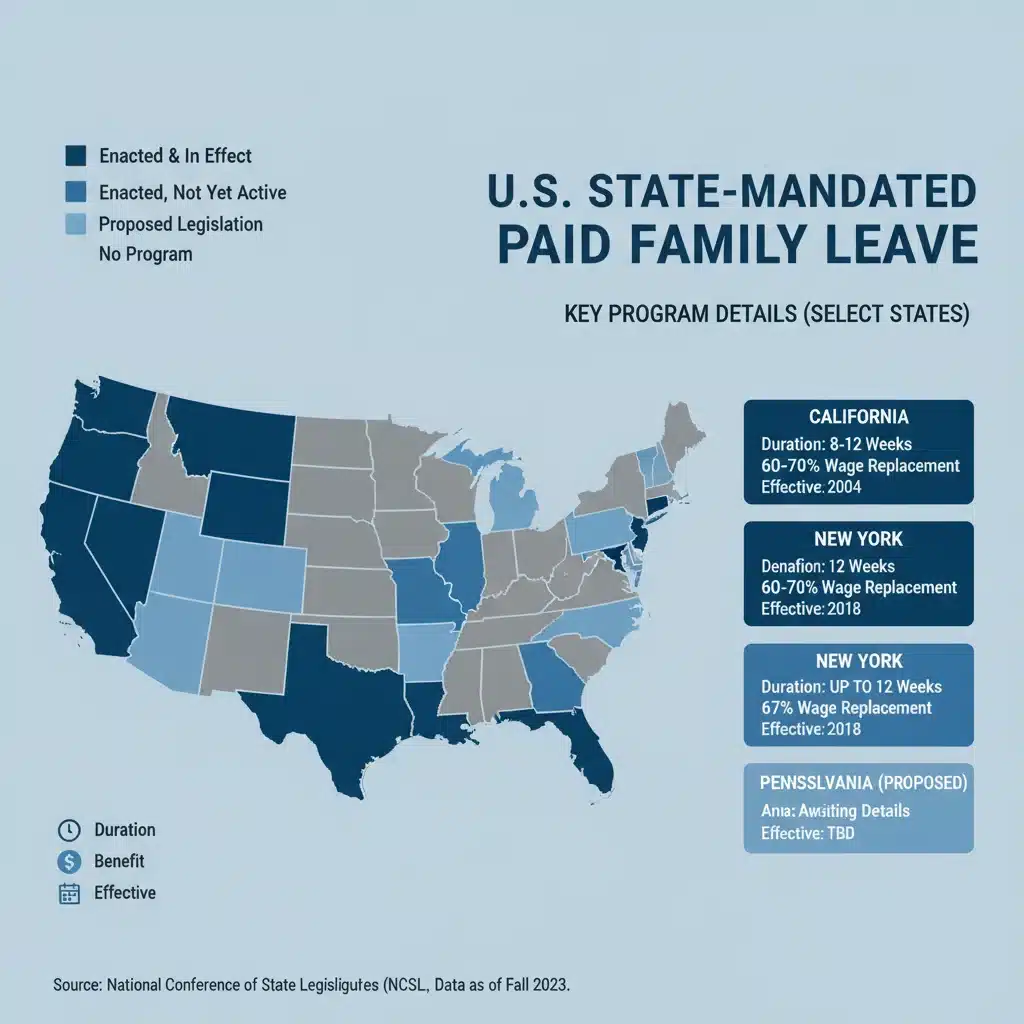
State-Specific Paid Family Leave Programs in 2026: A Closer Look
Given the state-by-state variation, a deeper understanding of specific programs is invaluable. While we cannot cover every state in detail, here’s a look at how some prominent state paid family leave programs might operate in 2026, highlighting common features and potential differences. Keep in mind that legislative changes can occur, so always verify the latest information.
Key States with Paid Family Leave (PFL) Programs
- California (CA PFL): One of the pioneering states, CA PFL typically offers up to 8 weeks of partial wage replacement (60-70% of wages, up to a maximum weekly benefit) for bonding with a new child, caring for a seriously ill family member, or military exigencies. It’s integrated with State Disability Insurance (SDI).
- New York (NY PFL): NY PFL offers up to 12 weeks of paid family leave, with benefits set at a percentage of your average weekly wage, capped at a percentage of the statewide average weekly wage. It covers bonding, care for family members, and military exigencies.
- New Jersey (NJ FLI): NJ Family Leave Insurance (FLI) provides up to 12 weeks of paid family leave. Benefits are a percentage of your average weekly wage, up to a maximum weekly amount. It covers bonding and caring for a seriously ill family member.
- Washington (WA PFL): Washington’s paid family leave program offers up to 12 weeks for family or medical leave, or a combined 16 weeks for multiple events, with benefits calculated as a percentage of your weekly wages, up to a cap.
- Massachusetts (MA PFML): MA Paid Family and Medical Leave (PFML) provides up to 26 weeks of combined family and medical leave in a benefit year. Family leave covers bonding and care for family members. Benefits are a percentage of your average weekly wage, with a maximum weekly benefit.
- Connecticut (CT PFL): CT Paid Leave offers up to 12 weeks of wage replacement for qualifying reasons, plus an additional 2 weeks for incapacitation during pregnancy. Benefits are calculated as a percentage of your average weekly earnings, up to a maximum.
- Oregon (OR PFML): Oregon’s Paid Family and Medical Leave Insurance (PFMLI) program offers up to 12 weeks of paid leave, with an additional 2 weeks for pregnancy-related conditions, for a total of 14 weeks. It covers family, medical, and safe leave. Benefits are progressive, replacing a higher percentage of wages for lower-income earners.
- Colorado (CO FAMLI): Colorado’s Family and Medical Leave Insurance (FAMLI) program provides up to 12 weeks of leave, with an additional 4 weeks for pregnancy or childbirth complications, for a total of 16 weeks. Benefits are a percentage of your average weekly wage, up to a cap.
- Maryland (MD PFL): Maryland’s Paid Family and Medical Leave program is set to be fully implemented by 2026, offering up to 12 weeks of paid family leave (24 weeks if combined with medical leave). Benefits will be a percentage of your average weekly wage, up to a maximum.
- Delaware (DE PFL): Delaware’s Paid Family and Medical Leave program is also scheduled for full implementation by 2026, providing up to 12 weeks of leave for various reasons, with benefits capped at a percentage of the statewide average weekly wage.
This list is not exhaustive, and other states may have enacted or be considering paid family leave programs by 2026. Always check the official state government websites (e.g., Department of Labor, Employment Development Department) for the most current and accurate information regarding eligibility, application procedures, benefit rates, and covered reasons in your specific state.
Strategies for Maximizing Your 12 Weeks of Paid Family Leave
Now that we’ve covered the basics, let’s explore practical strategies to ensure you make the most of your paid family leave entitlement in 2026, potentially even extending your time beyond the standard 12 weeks.
1. Plan Early and Communicate Proactively
The single most important strategy is early planning. As soon as you anticipate a need for paid family leave (e.g., pregnancy, planned adoption, impending caregiving needs), start researching your options. This includes:
- Reviewing Employer Policies: Obtain a copy of your company’s family leave policy. Understand their specific requirements for notification, documentation, and coordination with state benefits.
- Understanding State Laws: Visit your state’s official paid family leave website to understand eligibility, application timelines, and benefit calculations.
- Notifying Your Employer: Most programs require advance notice (e.g., 30 days for foreseeable leave). Proactive communication with your HR department or supervisor ensures a smoother process and allows your team to plan for your absence.
- Creating a Timeline: Map out your expected leave duration, considering any waiting periods for benefits, and coordinate with your partner if applicable.
2. Stack and Combine Benefits Strategically
This is where the real maximization happens. In many cases, you can combine different types of leave to extend your time off and maintain financial stability:
- FMLA + State PFL: If you are FMLA-eligible, your state paid family leave will often run concurrently with FMLA. This means FMLA protects your job, while the state program provides wage replacement. This is the most common combination.
- Employer PFL + State PFL: Some employers allow you to supplement state paid family leave with their own benefits. For example, if your state pays 70% of your wages, your employer might pay the remaining 30% to bring you to 100% wage replacement for a certain period.
- Employer PFL + Short-Term Disability (STD): For birth parents, short-term disability (either employer-provided or state-mandated, like in CA, NJ, NY) typically covers the physical recovery period after childbirth (e.g., 6-8 weeks). Once STD ends, paid family leave can kick in for bonding time. This effectively extends the total paid time off.
- Accrued PTO/Sick Leave: Many employees use accrued vacation, sick leave, or personal time off (PTO) to supplement their paid family leave. You might use PTO to cover any waiting periods for state benefits, or to extend your leave after paid family leave benefits are exhausted, often topping up partial wage replacement to full pay.
Always confirm with your HR department how different leave types interact and if they run concurrently or consecutively. This is crucial for planning your full 12 weeks and beyond.
3. Understand Intermittent Leave Options
Not all leave needs to be taken consecutively. Many paid family leave programs, as well as FMLA, allow for intermittent leave. This means you can take leave in smaller increments (e.g., a few days a week, or a few hours a day) rather than one continuous block. This can be particularly useful for:
- Caregiving: Attending regular medical appointments for a seriously ill family member.
- Gradual Return to Work: Easing back into work after a significant life event by working part-time for a period.
- Flexibility: Adapting to unpredictable needs, such as a child’s doctor appointments or school events.
If you plan to use intermittent leave, discuss it with your employer and the state agency administering the paid family leave program to understand their specific requirements and how it impacts your total leave entitlement.

4. Financial Planning and Budgeting
Even with paid family leave, you’ll likely be receiving only a percentage of your regular income. Comprehensive financial planning is essential to ensure a smooth transition and avoid stress during your time off:
- Create a Budget: Understand your expenses during your leave period. Identify areas where you can cut back temporarily.
- Save in Advance: If possible, save money specifically to cover the difference between your paid family leave benefits and your full salary. This can make a significant difference.
- Review Other Benefits: Check if your health insurance premiums or other benefits will continue during your leave, and if there are any changes to how they are paid.
- Tax Implications: Be aware that paid family leave benefits are typically taxable income. Factor this into your budgeting.
5. Understand Your Rights and Protections
Knowledge is power. Familiarize yourself with the protections afforded to you under FMLA and state paid family leave laws:
- Job Protection: FMLA provides job protection, meaning you have the right to return to the same or an equivalent position after your leave. Many state PFL laws also offer similar job protection.
- Non-Discrimination: It is illegal for an employer to discriminate against you for taking or inquiring about paid family leave.
- Health Benefits: Under FMLA, your employer must maintain your group health benefits during your leave as if you had not taken leave. State PFL laws often have similar provisions.
If you encounter any issues or believe your rights are being violated, contact your state’s labor department or an employment law attorney.
Common Questions and Misconceptions about Paid Family Leave
Navigating paid family leave can bring up many questions. Addressing some common misconceptions can help clarify the process.
Is FMLA paid leave?
No, FMLA (Family and Medical Leave Act) provides job-protected leave but it is unpaid. Paid family leave benefits typically come from state programs or employer policies, which can run concurrently with FMLA.
Can I take Paid Family Leave for any family member?
The definition of ‘family member’ varies by state. Most programs cover spouses, children, and parents. Many states have expanded this to include domestic partners, grandparents, grandchildren, and siblings. Always check your specific state’s definition.
What if my employer doesn’t offer paid leave?
If your state has a paid family leave program, you may still be eligible for state benefits even if your employer does not offer its own. Employer size requirements for state programs are often lower than for FMLA, or they apply to all employers in the state.
Do I have to take all 12 weeks at once?
Not necessarily. While many people opt for a continuous block of leave, many programs allow for intermittent leave (taking it in smaller increments) or reduced schedule leave, particularly for caregiving or serious health conditions. Bonding leave for a new child can often be taken any time within the child’s first year.
Will taking paid family leave negatively impact my career?
Legally, no. FMLA and most state paid family leave laws offer job protection. However, some individuals worry about perceived career impacts. Open communication with your employer, proactive planning, and a strong handover plan can help mitigate these concerns. The growing acceptance of paid family leave in the workplace also helps normalize its use.
The Future of Paid Family Leave in the US
As we move towards 2026 and beyond, the trend towards more accessible and robust paid family leave continues. There is ongoing discussion at the federal level about establishing a national paid family leave program, which would standardize benefits across all states and potentially simplify the current fragmented system. While a federal program hasn’t yet materialized, the increasing number of states adopting their own policies, coupled with growing employer support, indicates a strong societal recognition of the importance of paid family leave.
Businesses are increasingly realizing the benefits of offering paid family leave, including improved employee morale, reduced turnover, enhanced recruitment, and greater gender equity in the workplace. This growing understanding is likely to lead to even more comprehensive and generous policies in the years to come.
Conclusion
Maximizing your paid family leave in 2026 requires a proactive approach, a thorough understanding of federal, state, and employer policies, and strategic planning. By researching your eligibility, understanding benefit calculations, and exploring options to combine different types of leave, you can ensure that you utilize your full 12 weeks – or even more – to focus on your family and personal well-being without undue financial strain.
Remember to communicate early and often with your employer and consult official state resources for the most up-to-date and accurate information. Paid family leave is a valuable benefit designed to support families during life’s most significant moments. By being informed and strategic, you can confidently navigate the process and make the most of this essential time off.